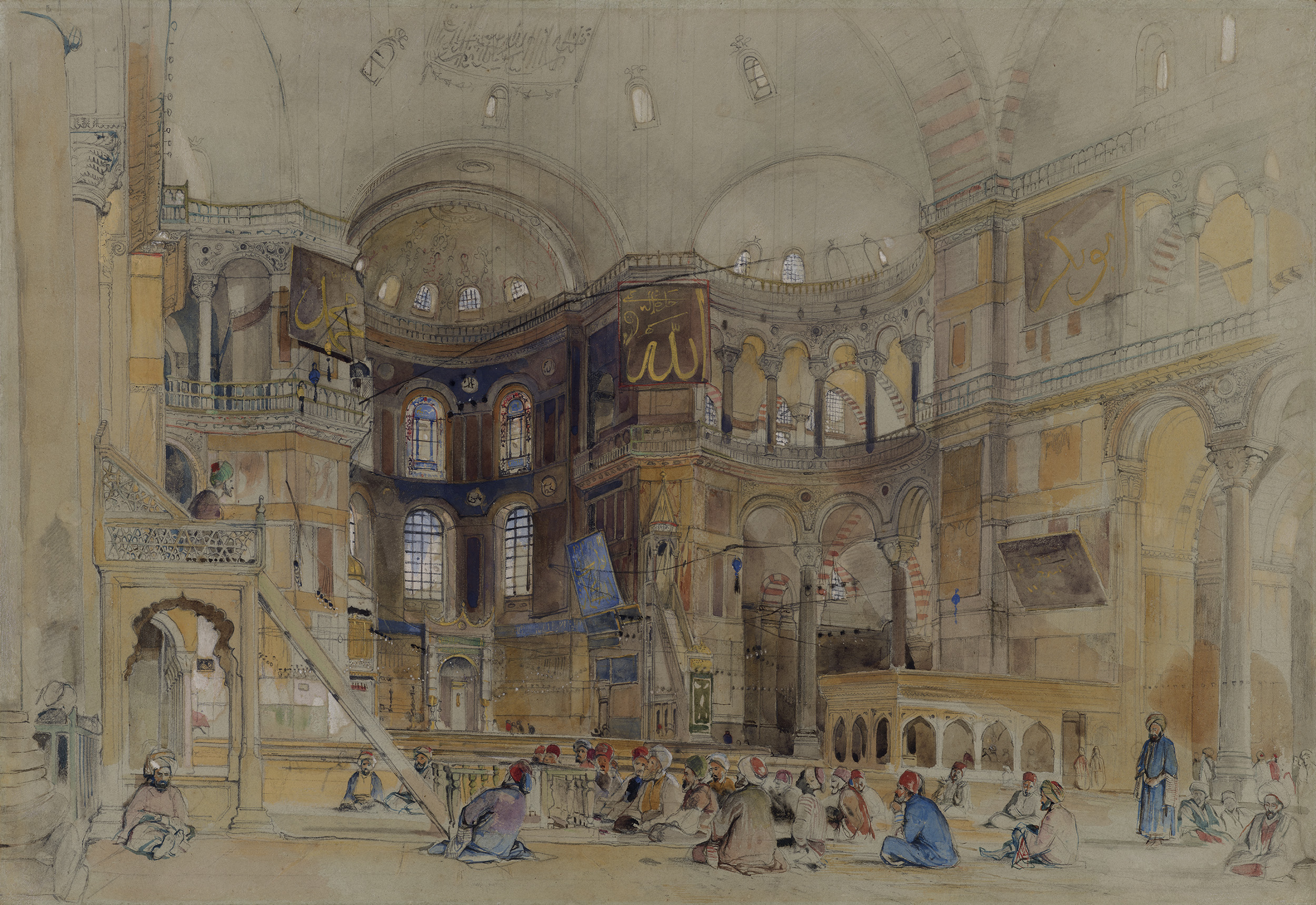
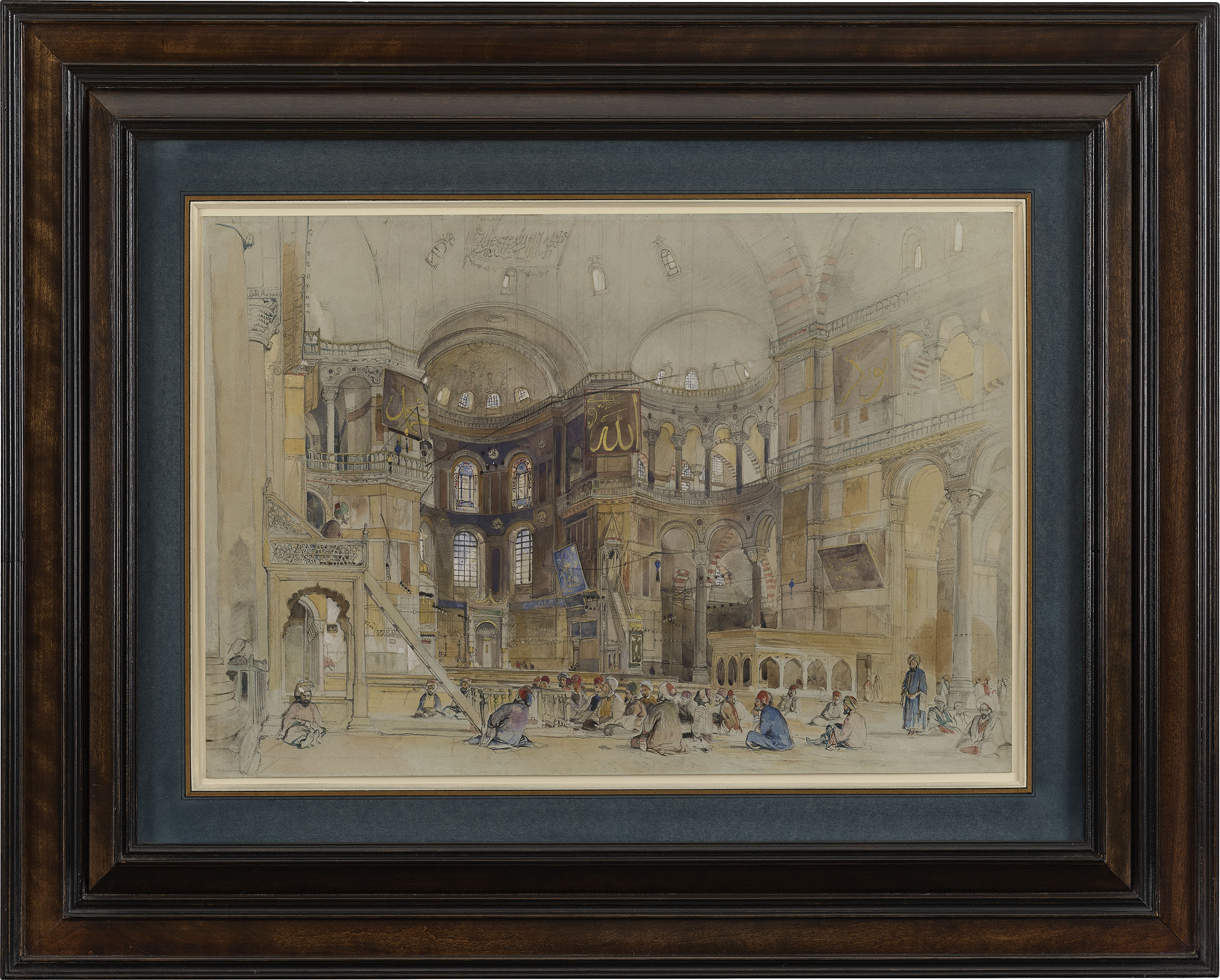
This exceptional watercolour was made in Istanbul in 1840 by John Frederick Lewis. Showing the interior of the great mosque of Hagia Sophia, Lewis captures the complex architecture of the sixth-century church with its fifteenth-century Ottoman additions, populated by contemporary figures at prayer. Exquisitely delineated in graphite on grey paper, Lewis captures the glittering, jewel-like interior in rich watercolour, preserved in outstanding condition, this beguiling work is one of Lewis’s acknowledged masterpieces.
John Frederick Lewis was part of a generation of painters who travelled East in search of new and exotic material. Trained by his father, the engraver Frederick Christian Lewis, Lewis developed friendly ties with the Landseers and like Edwin Landseer, his earliest exhibited works focused on animals. Lewis spent time working as an assistant to Thomas Lawrence and was probably responsible for adding animals to Lawrence’s portraits. From 1832 Lewis toured Spain, staying with the traveller Richard Ford and his wife in Seville. Lewis exhibited numerous watercolours based on his Spanish trip at the Royal Academy and Watercolour Society, but the chief result of the tour were two albums of lithographs: Lewis’s Sketches and Drawings of the Alhambra (1835) and Lewis’s Sketches of Spain and Spanish Character (1836). This remarkable body of work brought into focus Lewis’s professional preoccupation with the intricacies of Islamic architecture and the dress of different communities. Following the success of his Spanish work Lewis plotted a trip through eastern Europe to Egypt. In 1837 he left Britain, spending the winter in Paris before moving to Italy in early 1838. Lewis stayed in Rome until 1840 when he travelled via Albania, Corfu, Athens and Smyrna to Constantinople, modern day Istanbul.
In travelling east, Lewis was very much following in the footsteps of other British artists including David Roberts, William James Müller and David Wilkie. Lewis was particularly influenced by Wilkie as both a draughtsman and painter. On his arrival in Constantinople, in late 1840, Lewis met Wilkie who wrote home to the painter William Collins: ‘we have encountered John Lewis from Greece and Smyrna. He is making a number of drawings. I said I was sure he would turn up on our route… he has been making most clever drawings as usual.’[1] The clever drawings seem to have been focused on the architecture of the great mosques. Lewis made a series of studies of the Grand Mosque at Bursa, including views of the Mausoleum of Sultan Mehmet, but most numerous are the detailed views of the interior of Hagia Sophia. Working on distinctive grey paper Lewis produced at least seven studies of the interior of the great domed mosque, evidently beguiled by the combination of early Christian basilica and delicate Ottomon decoration.
During his residence in the city, Lewis spent time amongst the British community completing a portrait of the British ambassador to the Sublime Port, John, 1st Viscount Ponsonby. Frances Vane, Marchioness of Londonderry in her chatty travelogue Narrative of a visit to the Courts of Vienna, Constantinople, Athens, Naples &c. published in 1844, reveals Lewis acted as her guide to Constantinople’s mosques. Her description of a visit to Hagia Sophia paints a particularly evocative portrait of the British response to the great mosque:
‘On entering the mosque of St. Sophia, we found it filled with true believers engaged at their devotions, and we were advised to walk up stairs. We climbed up a dark, paved, inclined plane, reached the galleries that run round, and, leaning over, had a full view of the whole. The first thing that strikes the mind is the immense size. Mr Lewis, the painter, who accompanied us, said it was certainly larger than St Paul’s; and, from the great open space, it appeared larger than St. Peter’s at Rome… from the circumstance of its being the Ramazan [Ramadan], and twelve o’clock being the hour of prayer, we saw what Christians are seldom allowed to witness – the Mussulams at their devotions. Not a footfall was heard; the whole being covered with Turkey carpets, which Mr Lewis observed, all veered one way, the pulpit being inclined sideways to face them…the Turks were ranged in long lines, and there might be about seven hundred. Nothing could be more resplendent and picturesque than the coup d’oeil, and the light falling on the different coloured robes, violet, blue, scarlet, and green, all grouped together… On descending from the galleries, we walked round the mosque, the prayers were over, and the people dispersing; but one old Turk, in a pink robe and voluminous turban had ascended a seat, and was expounding the Koran.’[2]
In his depiction of the interior of Hagia Sophia Lewis does not show the moment of prayer but the scene described by Lady Londonderry of a mullah preaching from one of the elaborate marble kürsü, or pulpits under the dome. Lewis beautifully captures the rapt congregation listening to the seated preacher. Unlike Lewis’s more highly composed and finished exhibition works, this study displays an unusual degree of naturalism. Lady Londonderry’s account is inflected by a western delight in the exotic and picturesque. In her description of prayers in Hagia Sophia she states that they: ‘gazed upon long ranges of huge-rolled turbans. Hardly any of the new ugly fez were here.’ By contrast, Lewis shows the majority of the congregation wearing the new Ottoman headgear, suggesting Lewis’s interest in verisimilitude. Lewis himself nearly always populated his finished Turkish watercolours with figures in turbans, adopting one himself in his thinly veiled self-portrait In the Bezestein, El Khan Khalil, Cairo (The Carpet Seller), now in Blackburn Museum & Art Gallery and in two photographs showing him in Oriental costume taken in around 1860.
This raises an interesting question about the nature of Lewis’s watercolour, its purpose and position within the complex discourse surrounding Orientalist art. Meticulously plotted in pencil on grey paper, Lewis shows a remarkable level of accuracy in his depiction of the interior. Hagia Sophia is shown before a campaign of restoration in the 1840s, when the distinctive calligraphic roundels were added to the piers by Kazasher Mustafa Izzet Efendi. Lewis shows the earlier square banners still in place. Architecturally, Lewis precisely shows the mihrab in the apse added in the fifteenth century by Mehmed II, flanked by two large candlesticks brought from Hungary by Suleiman the Magnificent. Lewis shows the minbar with its distinctive canopy and the lines of bronze wire criss-crossing the dome supporting blue glass lanterns and ostrich eggs. The whole watercolour is handled with remarkable fluency and clarity, capturing the cavernous space and its intricate, layered decoration, with a candour that is not associated with Lewis’s exhibition works.
Much has been written about Lewis’s complex relationship with Muslim subject-matter, his depictions of Egyptian interiors and genre scenes. Lewis revelled in combining scrupulous observation, particularly accurate architectural detail, with figures from a cast of eastern tropes conjured from the European imagination. But in Lewis’s ingenuous, naturalistic studies, such as this scrupulously observed interior view, he seems more interested in capturing a complex modern scene. Lewis records the racial mix of contemporary Ottoman Constantinople, men in the modern fez seated next to those in the traditional turban and at the centre of the group a young black man, at this date Ottoman territory extended across North Africa. Preserved in exceptional condition, this is one of Lewis’s grandest and most consequential drawings remaining in private hands.

John Frederick Lewis
Interior of the Mosque of Aya Sofya, Istanbul
Watercolour
14 ¼ x 18 ¾ inches; 362 x 476 mm
Drawn in 1840-1
© Victoria and Albert Museum, London